

Rocky Mountain Public Media, the home of Rocky Mountain PBS, KUVO Jazz, and TheDrop303 has developed a partnership with Colorado Ethnic Media Exchange to launch this monthly essay series, as part of our vision to co-create a Colorado where everyone feels seen and heard. These stories are sourced from community members across the state—told in their own words and selected from our 64-county community ambassador program. They are not editorial products of our journalism team, but are first-person reflections on life in Colorado – building bridges through empathy. To learn more about all of our brands and content, check us out at https://www.rmpbs.org/about.
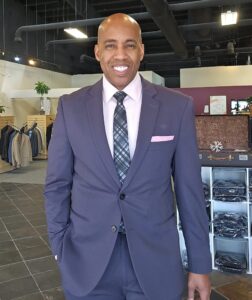
I am James Proby, the founder and proprietor of The Men’s Xchange in Colorado Springs, Colorado. Before that, I was the son of Rev. Milton Proby and Mildred Proby. Both were civil rights activists. My father was known as the state’s leading authority on civil rights, and my mother was, by my account, the first African American school teacher in School District 11.
Civil rights and equality were commonplace discussions in our home, and they are the reason both sides of my family ended up in Colorado Springs, leaving the segregation and oppression of the Jim Crow South. Colorado Springs presented itself as a place without the same blatant levels of segregation and racism found throughout much of the Southern United States. However, we were not completely free from it here either.
It is important to note that as a 56-year-old man, my sister, my cousins, and I are the first generation of Americans to live in a federally enforced desegregated society. This matters because we often think the Civil Rights Movement was eons ago, when in fact I am the first generation of Americans to live under equal opportunity protections by the federal government. I am also the first generation to go from kindergarten through high school in desegregated schools.
While federally regulated segregation had ended after more than 400 years, the social aspects of segregation existed then and persist today. All the schools I attended were touted as integrated, and they were. Yet in virtually every class I was in, from kindergarten through the completion of my undergraduate degree, I was usually the only African American face in the room. In my elementary school, I was one of only three African Americans in the entire building.
How often are you the only person of your color, race, or ethnicity in the room?
My father led the largest Black Baptist church in the state of Colorado, and most of the time there were no Caucasian congregants. If you attended First Presbyterian, St. Mary’s, or First Baptist Church, there were also no African Americans inside those walls either. Dr. King said that the most segregated hour in America is 11:00 a.m. on Sunday morning. So while segregation was rendered illegal by the federal government in 1963 and 1965, the reality is that the practice of segregation continued for decades to come.
Growing up in this environment allowed me to spend a great deal of time in school and social settings with my white brothers and sisters, seeing their souls and not their skin. While we formed meaningful friendships at school, most of my friends were not permitted to have me over to their homes after school. I could sit with them at the same lunch tables and study from the same workbooks, yet I could not enter their homes.
Socially, you could develop a crush on someone in your class, and even if those feelings were reciprocated, there was a generation above you that would not allow that relationship to flourish. The vestiges of centuries of separation persisted even in a place without the storied history of the Jim Crow South.
So how do we address this? We do it at a personal level, a professional level, a spiritual level, and a social level. Take stock of your own relationships and be brutally honest with yourself. Do not point to the one Black friend you have. Instead, ask why you do not have more, and question the depth of the relationships you do have.
Look at your professional spaces and ask why there are not more people of color in your office and in your industry. If you choose to worship, notice the level of diversity in the spiritual spaces you believe are inclusive. Equity and inclusion are not buzzwords. They mean equality and safe spaces for everyone.
What are you doing today to be part of the solution that ensures equality and safety? What are you doing today to help create a nation that has never fully existed, one truly rooted in the inalienable rights of life, liberty, and the pursuit of happiness, and that also ensures liberty and justice for all?
We Want to Hear from You
We’re inviting community members across the state to share their own stories of living in Colorado —of identity, discovery, and what it means to belong.
Tell us about a moment or a place in Colorado that changed how you see yourself or your community.
Share your reflections at ambassador64@rmpbs.org
This is part of Ambassador64, our statewide listening initiative to ensure public media reflects the voices of all 64 counties in Colorado—starting with yours.